Finally, the hidden objective of the UN bombing campaign began to loom over the horizon: dividing Libya into three countries. The constitutional amendment number 10 amends clause 12 of Article 30 of the NTC-imposed Constitutional Declaration (CD).
This amendment was reported to have been approved by the HoR on the 26th of November 2018, allegedly, by 123 MP's. This amendment divides Libya into three voting districts: the old colonial Tripolitania, Cyrenaica and Fezzan. This they said is required by the referendum law whose article 6 contradicts the NTC-imposed CD.
The amendment also states that if two-thirds of Libyans vote with yes then the permanent constitution will be adopted so long as the percentage of yes votes is more than 50% (that is a minimum of 50% + 1 is required).
The second article of the amendment states that the constitution project will be rejected if it does not meet all the above conditions; while the third article makes this latest saga effective from the date of publication: 26/11/2018.
Violations:
The draft constitution was announced on the 29th of July 2017. Most Libyans rejected the draft outright for its blatant violations of basic human rights; and yet the authorities kept silent ever since (16 months). Now it is almost certain these violations will remain so for [some] people to vote on.
Many Berberists have protested about both the procedure and the draft itself for years but, as usual, no one is interested in dispensing justice for the marginalised natives of Libya.
This means that the two-third majority stipulated by the HoR will be mainly Arab majority because the native Berbers have already boycotted this mysterious process, as reported by https://www.temehu.com/constitutions.htm
The number of Libyans was a mere 4 million when the February Operation began. Now it is reported that millions of foreigners were given fake Libyan ID's by the authorities in Tripoli for the sole purpose of voting (as reported elsewhere). This means that it is doubtful if any voting operation in Libya can be considered transparent from now on; and in fact none were in the past either, as reported by https://www.temehu.com/gnc (under the 7/7 Elections tab).
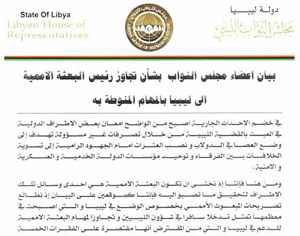
The HoR session to vote over and pass these latest amendments was not televised as usual and therefore critics say there was no evidence that the alleged numbers announced by the HoR are correct. According to Nadia Omran (CDA member herself) it has not been determined yet how many members had attended the session and therefore one is unable to conclude the legitimacy of the session [1].
Some critics questioned the legitimacy of the session by saying it is unusual that many members of the HoR have met over this amendment despite the lack of such attendance during the previous years [1].
Some critics have already reported that 120 members of the HoR are loyal to Tripoli's Brotherhood and that the HoR and the HCS (and thus the PC) are working together to ensure the Brotherhood takeover of Libya [2].
According to the HoR MP Hamoudda Sayala, the amendment to immunise Article 6 of the referendum law violates the elementary standards of the equality of citizens. According to Libya Observer, Mr. Sayala said: "There is no such thing as constitutional immunity of a law, either the article is part of a law or a constitutional article, which both must be approved by specific voting mechanisms" [3].
CD Amendment 11 (التعديل الدستوري رقم 11):
The second amendment (also passed on the same day) approves the amendment to the UN-imposed LPA as agreed (without saying what this agreement was) and includes this amendment in the Constitutional Declaration (CD); while the second article states that this amendment is effective from the 26th of November 2018.
Violations:
The HoR had previously refused to approve the UN-imposed PC and its head the UN-imposed Fayez Serraj, even though the HoR was happy to negotiate with both the PC and the HCS ever since.
Despite the illegal formation of the PC's HCS (in violation of the CD) the HoR now violates its own house rules by sharing it legislative power with an illegal body.
Critics also say that the latest amendment does not cover a fraction of the UN-imposed LPA as was required ever since December 2015 (when it was first imposed by the UN). According to HoR member Mesbah Douma the HoR did not fortify the entire LPA in the constitutional Declaration [4]: قال عضو مجلس النواب عن سبها، مصباح دومة، إن المجلس لم يعتمد الاتفاق السياسي كاملا في الإعلان الدستوري
In short it is evident that the authorities (together with their international friends) continue to impose further violations to extend the agony initially imposed on Libyans by the UN.
According to many Libyan politicians and analysts the UN has no interest in helping the Libyans, let alone protecting the Libyan civilians "by all necessary measures".
To the contrary, most Libyans say, the UN's activity clearly revolves around the destruction of Libya's unity after having destroyed Libya's entire infrastructure before letting-it-be-infected with terror and chaos. Listen to this discussion, for example, and this one, and many more if you care.
Many Libyans believe the UN is the main reason behind extending the Libyan tragedy, and as long as the UN continues to interfere in Libya's sovereignty the agony will not disappear; it will get worse, they say.
The UN claimed to be helping the Libyans for the past seven years and yet there is no solution on sight, except more mayhem, more disasters, more governments, more violence, more violations, more suffering, more pain, more darkness, and hundreds more of mind-boggling UN-inflicted tragedies that no one dares to mention.
From Libyan perspective, if there is an organisation that is evil in this world it has to be the UN — meaning the hijacked UN, and not the UN the 'concept' the people aspire to worldwide.
Why?
Because of its sheer hypocrisy of talking about peace whilst authorising violence against a helpless, weak nation like Libya.
And authorising violence for (the alleged) protection of civilians, or for whatever else the masters say, is debatable, but authorising violence based on lies is, without a doubt, the crime of the century.
On the other hand, authorising violence based on lies to destroy the country and then abandon it to the clutches of world terrorists and criminals only to turn round a few years later to say their Libya job was "unintentional mistake" is, without a doubt, pure evil. It does not require a degree in political science.
This has convinced many Libyans (and many more from around the world) that the UN is not a peaceful union of the world's nations; it is an aggregation of the ten most richest and powerful states in the world. All UN resolutions are meaningless and can only be implemented when the big ten say so. Surely everyone agrees this is not a world union as we know the word.
That is the UN is a deceptive, smart system designed to manipulate the planet according to hidden agendas (agenda 21, agenda 2030, etc.), where elite leaders can walk in and come out with bombing-warrants to bomb sovereign nations based on lies — the lies they later claim to have been no more than "un-intentional mistakes". The lies that ruined the lives of everyone in Libya. The lies that ruined the lives of everyone in Libya, except perhaps the installed elite. The lies that ruined the lives of everyone in Libya. The lies that ruined the lives of everyone in Libya . . .
The following is only a small list of the violations committed by the UN in Libya, so far (latest first):
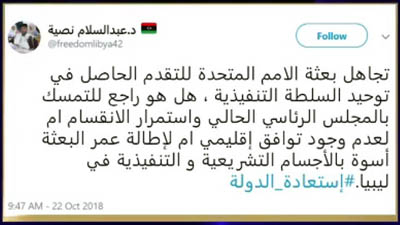
22 - Is the UN Prolonging The Political Division in Libya, Mr. Nassia Asked?
22 October 2018
The Chairman of the HoR's Dialogue Committee (of the elected Libyan parliament), Mr Nassia, has expressed his concerns regarding the UN's disregard for the recent progress achieved between the HoR and the HCS in relation to uniting the executive authority. Mr. Nassia asked if the UN's lack of response is due to the UN's desire to extend the division amongst the two governments in Libya, or else due to the UN's desire to prolong its mission in Libya [18, 19].
Of course, the question is: what is the UN's mission in Libya? Is it to divide Libya into three states or spread weapons and wars across the whole region?
21 - UN Imposes A Third Government on The Will of The Libyan People
2018
Having imposed its second government (namely the PC) the UN now is in the process of imposing a third government through its 20SRM and the 2018 elections. Like before, most experts agree that the forthcoming elections would definitely destroy Libya because of lack of security institutions and because of the absence of a unified army to ensure protection for the new government. This time round the third UN-imposed government may exile itself to Fezzan, thereby creating three governments in Libya — governments by the bucket. Let us hope these three governments keep Libya's three regions (Tripolitania, Cyrenaica and Fezzan) united.
The fact that this latest ploy from the UN was enacted in Paris (and thus the so-called Paris Agreement [PA]) shows that southern Fezzan may end up under the influence of colonial France (in line with Mali and Niger), while Tripolitania's brotherhood would be supported by the West, and Cyrenaica's army by the East (and thus Russia's support for Haftar's Arab Army).
The UN has already proved to the whole world that it is a useless organisation that has failed the Libyan people when its imposed PC (else known as GNA) failed to achieve anything at all but more mayhem, more militia groups and more wars. Why should the Libyans, or anyone else for that matter, trust the UN ever again?
The UN itself admitted that the PC they imposed on the Libyans has failed and that only elections (of a third government) would see Libya out of the UN-imposed quagmire. Really?
Elections without providing any security; elections without dismantling the hundreds of militia groups, many of which were created, armed and trained by Western states in 2011 — the militias the Skhirat agreement said must be abolished or integrated into the army and yet the illegal GNA created more militias while the UN stood watching.
How can this be allowed? Why is the UN allowed to commit violation after another while the Libyans continue to suffer the consequences of the horribly-gone-wrong imposed protection?
Go home UN and leave us alone; the Libyans had enough with your destructive protection, useless plans, implicit agendas, and un-intentional mistakes.
20 - UN Stipulates Libyans Sign Acceptance of Election Results in Advance
April 2018
The UN continues to impose its strange policy to drive Libya towards division despite the Libyans' opposition to all international interference in Libya's sovereign affairs. The latest UN violation stipulates that the Libyans provide guarantees to the UN that they will respect the outcome of the forthcoming results no matter what.
This is impossible to implement because the Libyans have already told the world that it was the UN's dictatorship that imposed the various militias on the will of the Libyan people and that as long as these militias are still protected there will never be success in Libya of anything, let alone fascist elections that barred the natives from constitutional rights.
Who is going to provide the guarantee? Is it the radical militias or the installed terrorists? Or is it the opposition? The Libyans had already elected many governments so far and therefore why would they need to elect another disaster?
19 - 67 HoR Members Condemn UN Actions in Libya
16 April 2018
Sixty seven HoR members (of the Libyan Parliament) have condemned UNSML's role in Libya as “a blatant interference in the Libyan affairs”. They said it is becoming apparent that the "international parties" are "tampering" with the Libyan issue by obstructing efforts to resolve the problem.
Although the 67 MPs expressed fears that the UN might be a tool for such international parties to achieve their hidden agendas, to most Libyans it is clear that the UN itself is using the international parties to effect its implied objectives to reshape the world's borders and redistribute resources according to its hidden agendas.
To most Libyans the UN now is nothing but a dictatorial organisation that uses protection to destroy countries in a slow process that drags-on for years upon years of pain and suffering. Their constant meddling in Libya's affairs that are driving Libya towards division are the best evidence for such hidden agendas. It is not the words that matter but the actions and the results that speak volumes without a single, rotten word.
The 67 MPs said the UN continues to extend the Libyans' agony by pushing for a fourth transition phase that is not based on a final constitution. The irony is that many Libyans said this immediately after the NTC imposed its foreign-written Constitutional Declaration in 2011 but no one took notice.
18 - UN Proposes Yet Another Rejected Initiative
21 November 2017
UN's proposal for amending the LPA in relation to the executive government was accepted by the HoR [22] but rejected by the HCS [23].
17 - UN Decides 2018 Elections Will Go Ahead Regardless !
28 November 2017
The UN once again has decided to impose its authority by continuing to meddle in Libya's affairs. Shockingly, this time the UN has decided that the 2018 elections will go ahead regardless of whether the Libyans have reached an agreement or not over the UN-proposed road-map. Of course, the UN knows best what is best for Libya; after all they have been doing just that for seven years now - and still counting to *armajadoooooooooooooooooon.
16 - UN Specifies Election Conditions
2 December 2017
The UN imposes a new set of conditions according to which the 2018 elections will be held in Libya. The UN also decided that voter registration can start this month. Thank you very much. Among the conditions stipulated are:
Technical condition: registering as many voters as possible for the upcoming elections to ensure adequate participation.
Legislative condition: the existence of legislative preparation according to which the elections would be completed.
Political condition: all parties should agree to accepting the results of the forthcoming third elections in advance — presumably even if the results end up tampered-with, as was the case in previous elections the UN called "transparent" — the elections that barred the Berbers from taking part in party elections; the elections in which ballot boxes were swapped by installed militias.
15 - HoR Member Condemns UN Actions
30 December 2017
HoR member Esa Alareibi condemns the recent actions of the UN mission in Libya: condemns the bizarre behaviour of the UN: النائب عيسى العريبي يستهجن التصرفات الأخيرة للبعثة الأممية في ليبيا
[3]
14 - Activist Azza Maghur Accuses UNSMIL of Double Standards
December 2017
It makes one feel at ease when other Libyans talk about the violations committed by the UN in Libya; at least you get the feeling that you are not alone.
The UN's rejection of the HoR's appointment of Mr. Shukri as the governor of the Central Bank of Libya, according to the Libyan lawyer Azza Maghur, contravenes the Libyan Political Agreement (LPA) as stated under Article 15.
The lawyer has also pointed out a number of violations to which the UN has turned a blind eye [13]. These include:
The illegal formation of the High State Council in violation of the LPA (as reported in this page immediately after it was formed: see the GNA's HCS tab );
The election of the presidency of the HCS;
The issuance of resolutions by the Presidential Council in violation of the LPA;
The non-replacement of a member of the Presidency Council who resigned;
The formation of the GNA without the approval of the HoR;
The conclusion of a bilateral agreement on illegal immigration by the Presidency Council without jurisdiction;
The continuation in power of the PC and the GNA despite the expiry of the LPA’s two-year limit;
The failure of the first phase of the 20 of September Road Map (conducted by Ghassan Salame) without reaching consensus between the HoR and the HCS. The HoR had accepted the initiative proposed by Salame (in relation to amending the LPA) but the HCS had rejected it, and yet Salame said nothing.
13 - The 20 of September Road Map Disaster
September 2017
The UN and its allies appear to be addicted to imposing inititives that are doomed to fail. One of the most recent failures is the so-called the 20 of September Road Map [20SRM], which we covered in detail in our GNA page. The following observations illustrate that the whole initiative is wrong, from start to end.
One of the first criticisms voiced was that the 20SRM was born dead, just like the birth of the PC itself.
Many Libyan politicians stated from the start that the 20SRM is nothing more than an attempt to delay stability in Libya and extend the state of chaos engulfing Libya since the UN-authorised bombing campaign was ignited with vengeance.
It is not possible for Mr. Ghassan Salame to come up with such a dramatic road-map in this short period of time, Mr. Ezzedin Aqil told Sijal [34]; indicating that the plan was already crafted by other unknown entity (or entities).
According to Omar Ehmidan, former spokesman of the former GNC, this road-map proposed by Salame was put forward by Kobler in June 2016 [34].
One of the first HoR members to respond to such road-map, Mr. Abdulminaem Balkour (عبد المنعم بلكور), was reported to have said that the proposed UN road-map is incomplete and requires clarification [35]. For example there was no mention of the actual LPA articles that require amending, he said. This point alone leaves the door wide open, once more (just like in December 2015), for further disagreement and discord.
Other analysts say most European players are also extending the agony for personal gains and a slice of the "ungoverned space", and therefore many Western states had already declared their support for such disastrous Road-Map. Hence the 20th of September Road-Map, according to CDA member Thow Almansori (ضو المنصوري), is an earthquake and a hurricane that would destroy the political process in Libya and drag the country to its pre-2011 state [34].
The 20SRM stipulates amending the Libyan Political Agreement (LPA) that was earlier imposed by the UN in Morocco. Why did not they amend it before they imposed it in 2015? Most Libyans opposed the LPA from the start and yet no one took notice of their concerns! Once again, putting the cart before the horse is UN-intentional.
The 20SRM calls for creating a dialogue with the armed groups to integrate them in the political process. It must be noted that many of these groups are radical groups while others are plain terror groups operating in the open and yet the UN wants to negotiate with them. HoR member Dr. B'airah in this video (at 1:58:01) said when in 2014 the dialogue committee met with ambassadors from around the world to talk about forming an accord government (meaning the later GNA) he brought up the problem of militias in the capital and how they might affect the political processssss, the British ambassador (meaning Michael Aron), Dr. B'airah said, told him the international community will kick the militias out of Tripoli once the Libyans agree on an accord government. Interestingly, after the UN imposed its PC, Dr. B'airah said the international community let them down and never delivered their promise to kick the militias out of the stricken capital; which is clearly an act of deception, he added. Emshi, emshi! It must be noted that many of these militias were originally formed by the Western countries during the UN bombing campaign to topple Gaddafi, and they even trained, funded and "coordinated" them (British Foreign Secretary said), of course using Qatar and Turkey as a front for the later blowback.
It must be noted that the UN needs to know that its imposed LPA (in December 2015) calls for all militias to leave the capital, and yet the PC arrived only to create more militias with the UN's apparent silence (or implied approval), while the UN now is in the process of imposing yet another disastrous initiative which calls for negotiations with terrorists and armed groups. What else is there to say for heaven's sake other than go to hell UN.
According to Libyan lawyer Azza Maghur the HoR had accepted the initiative proposed by Salame (in relation to amending the LPA) but the HCS had rejected it, and yet Salame said nothing [13].
The already born-dead 20SRM was formerly killed on the 29th of May 2018 when delegates agreed to hold elections on the 10th of December 2018 during the so-called "Paris Agreement"; and therefore instead of LPA we now have PA
12 - The So-Called National Conference & The HD Lies
September 2017
The National Conference (NC, the المؤتمر الوطني or المؤتمر الجامع) is the latest trick to come out of the UN's sleeves to extend the Libyan agony. The NCP (the National Conference Process) is a series of conferences held across the country in preparation for the NC. The NCP will be held under the supervision of the UN. The UN has appointed another organisation to run the congress, namely the Centre for Humanitarian Dialogue (HD). So who is this HD?
Ironically the website of the UN-appointed HD (https://www.hdcentre.org/activities/libya/) starts its Libya introduction with a pack of lies. Here is how:
"On 15 February 2011, major demonstrations erupted throughout Libya seeking the removal of Muammar Al-Qaddafi."[2]
First of all there were no major demonstrations on the 15th of February 2011. This is a total lie. There was one, single, small protest by women and children on the 15th of February 2011 in Benghazi protesting about Abu Salim prisoners. Turning this to "throughout Libya" is obviously a massive lie, if not beating the drums for foreign invasion and regime change in Libya, as is usually the case.
Secondly this small protest did not call for the removal of Gaddafi; it was calling for the release of prisoners whom Gaddafi imprisoned in 1996 because they (the prisoners) were attacking European embassies in Benghazi from angry protestors who were protesting against the publication of the controversial "Danish cartoons" printed in Europe. This means that Gaddafi was protecting his European guests from violent hooligans.
Then the UN-appointed HD continues with more lies:
"They began peacefully but on 17 February, forces loyal to Qaddafi fired on demonstrators, killing hundreds and provoking resignations from some officials in Qaddafi’s own cabinet, several prominent Libyan diplomats and members of the security forces in the eastern region of the country."[2]
Thirdly, the UN-appointed HD claims that the following protests of the 17th of February began peacefully, which is also a lie, since by then we have many international organisations reporting the Libyan operation as an "armed conflict" in which [mysterious] protestors were shooting at government soldiers and burning government buildings.
Then the UN-appointed HD continues:
"Following a brutal campaign, which exerted a high toll on both sides, revolutionary forces finally overcame the last bastions of Qaddafi support in Sirte on 20 October. Qaddafi was found and killed while fleeing the city."[2]
To say revolutionary forces eventually toppled and killed Gaddafi is also a massive lie, because there was no mention of the simple fact that foreign military might representing nearly 50 countries were bombing Libya day and night for nearly 7 months, completely destroying Libya's entire infrastructure. There was no mention of the fact that Gaddafi's personal convoy was bombed by European military while leaving Sirte, after which he was killed.
Many Libyans believe that faking Libyan history in this manner is a serious violation. Such cheap lies can never justify the violent destruction of Libya by the so-called UN. The Libyans and probably all humans do cherish proper democracy, yes, but not on the expense of loosing their dignity and becoming cheap sheep instead. Please click here to o see a snapshot of the HD webpage regarding their lies about Libya.
11 - HoR Warns The UN With International Court
24 August 2016
رئيس مجلس النواب يهدد الأمم المتحدة بمقاضاتها أمام محكمة العدل الدولية في حال إستمرار تعاملها مع الرئاسي وحكومته
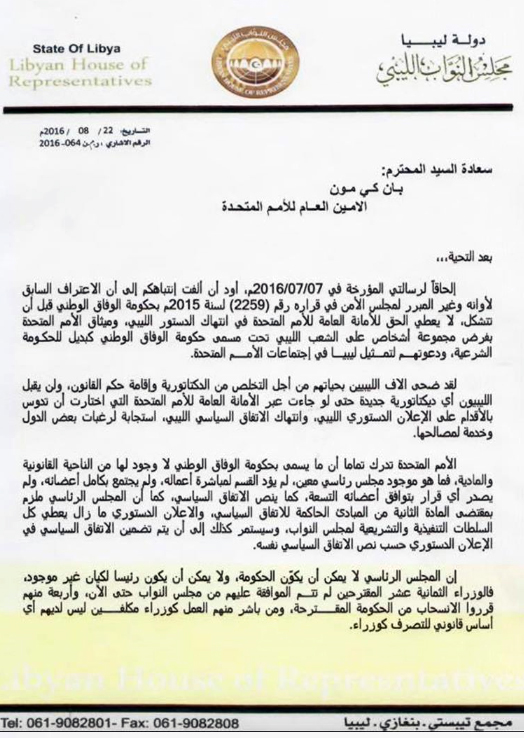
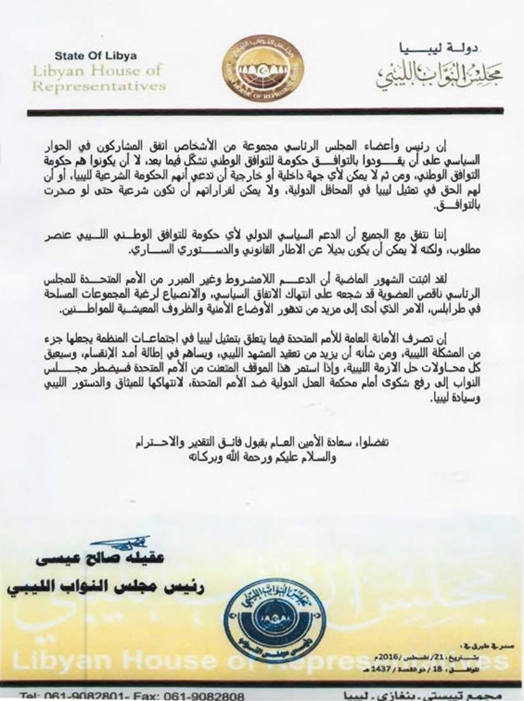
The HoR's president (the acting president of Libya Mr. Agila Saleh) was reported to have threatened to take the UN to the International Court (at the Hague) for the violations committed by the UN against Libya's sovereignty and against the Libyan constitution.
The HoR's president had stated in a letter addressed to the Secretary-General of the United Nations Ban Ki-moon on Tuesday (23/8/2016) that the conduct of the UN is unacceptable [9]. The letter is shown below.
Benghazi's LANA said the letter was sent to the UN via Libya's UN representative Mr. Ibrahim Dabbashi [10], and that the HoR asked the UN to stop dealing with the PC and its unapproved GNA after the HoR's vote (of the 22nd of August 2016).
The letter states that the representation of Libya at the UN creates more problems that may lead to further divisions among the Libyans. The letter said if the UN continues with such behaviour then the HoR shall be forced to take the UN to the international court for violating both Libya's sovereignty and the Libyan constitution.
The letter also warned that the UN's premature recognition of the GNA government (as occurred in its resolution 2259) long before the GNA itself is approved (and still has not been approved to date) does not grant the UN the right to violate the Libyan constitution.
The letter said that the UN has no right to impose a group of people under the name of GNA on the Libyan people and consider this group as the only legitimate government in Libya, and even give this government a seat at the UN.
The letter said the Libyans had sacrificed thousands of lives to get rid of dictatorship and thus will not accept any form of "new dictatorship" even if this dictatorship came via the United Nations, the organisation that chose to walk over the Libyan constitution: (للأمم المتحدة التي اختارت أن تدوس بالأقدام على الإعلان الدستوري الليبي ). [Wow]
The letter said the UN knows very well that the GNA does not exist yet, and that all there is is the PC which is instructed to form a GNA government and present it to the HoR for approval. [This point is very important because other western powers apparently began their second bombing campaign of Libya in Sirte in August 2016 based on an invitation from a government that does not exist - namely the GNA - just like the imaginary massacre of Benghazi for the first bombing campaign.]
The letter stated that the unconditional support of the UN to the PC, which acts as if it is the GNA, had contributed to the deterioration of the situation in Libya and also allowed the PC to be under the control of militias as well as to violate the LPA.
LANA said Mr. Dabbashi had asked the UN to formally direct its invitations to the legitimate authority in Libya as represented by the HoR and Althni's government [10].
The HoR's Letter warning the UN with international court
10 - The UN Recognises An Illegal Government
2016
The HoR had condemned the UN for recognising the GNA government imposed by the UN-imposed PC without the government securing the required approval from the elected HoR and without constitutional amendment. The PC had proposed two ministerial cabinets both of which were not approved by the HoR. The HoR (and all Libyans) have been waiting for the PC to propose its third (and last) government ever since the rejection of its second government.
Instead the PC authorised its government to operate without constitutional amendment and without the approval of the elected Libyan parliament. Soon afterward the whole world (including the UN) began dealing with the illegal government as the only legitimate government in Libya, and even striking lucrative business deals and imposing further mayhem on the stricken Libyan people; as well striking bombing warrants to bomb Libyan targets once more across the country, from Awbari to Tazebu and from Sirte to Sabratha — a second illegal bombing campaign that is still running to this day. Libya is being bombed illegally for seven years now and there is no sight of the alleged protection of civilians anywhere — just more and more terrorists appearing everywhere. Shame on you UN. Evil UN.
9 - UN's Apparent Approval of The HCS's Illegal Formation In Violation of The LPA
April 2016
The illegal formation of the High State Council in violation of the LPA was reported a few years ago in our HCS page. A few days after the PC's arrival in the capital Tripoli the HCS held its first meeting in Tripoli in open violation of the LPA; thereby reflecting the same chaotic start that eventually ruined the NTC, the GNC and the HoR. On the 5th of April 2016 some members of the HCS (said to be 73 members) held their first meeting in the capital Tripoli without approval from the parliament. On the following day pro-GNA GNC members (who are confusingly also being reported as members of the HCS) met in Almahari Hotel in Tripoli and agreed to make a constitutional amendment to the CD; yet again in open violation of the LPA and the NTC-imposed CD. According to this illegal amendment they disbanded the GNC (more-like they renamed it GNA), as well as appointed Mr. Abdulrahman Alsweihli the president of the HCS (with 53 votes), and Salah Almakhzoum as his first deputy (with 43 votes). This illegal violation of the imposed LPA and the CD was welcomed by the international community who shortly afterwards recognised it as the only legitimate government in Libya. Terrible.
When former rebel prime minister of the self-appointed NTC, Mr. Mahmoud Jibril, warned the UN via its envoy to urgently address the dangerous violations committed by the GNC members who self-amended the CD and elected a president for the HCS in violation of the so-called Libyan Political Agreement (LPA) the UN pretended deaf and blind [36]; and for the sake of audacity some European ambassadors even defended the violation (as we reported under our GNA's HCS tab). This means that the UN is continuing to commit violations even against its own agreements and there is no one to stop it/them.
8 - The UN Imposes Its Own President For The UN-Imposed PC
October 2015
One of the main violations eventually endorsed via the so-called LPA is the UN-imposed PC President Mr. Sarraj. Aljazeera also covered this violation right here [28]. The HoR nominated a list of 14 people for the PC presidency and thus the prime minister of the GNA on the 2nd of September 2015, but unfortunately the UN ignored the entire list and went ahead with imposing its own president. The List presented by the HoR includes the following names (13 men and 1 woman):
Mustafa Alsalheen Alhouni
Mhemed Abida Attargi
Nabeel Hemmadi Alghadamsi
Aboubaker B'airah
Mhemed Younis Lemnefi
Abdurrahman Shelgem
Dow Abdullah Bodawya
Abdulsalam Abduljalil
Fathi Almajberi
Almahdi Attabawi
Alaref Alnayed
Jadalla Azouz Attelhi
Othman Albaseer
Amal Attaher Alhaj
As you can see, the name Fayez Mustafa Alsarraj is not in the list.
Similarly, the latest UN-proposed National Accord Government, according to a GNC member [1], was assembled from those who were taking part in the negotiations before the GNC presented its list of candidates.
Probably as a disclaimer the website of the United Nations Support Mission in Libya [2] has confirmed this by stating that, "The GNC as you know decided yesterday not to propose names and to ask for more changes in the text."
لقاء خاص مع رئيس المؤتمر الوطني العام نوري أبوسهمين
GNC President, Mr. Nuri Abusahmein, reveals how the UN (via Mr. Leon)
imposed its PC on the will of the Libyan people without consultation with the GNC
(at minute 13:48).
This means that neither the HoR's nor the GNC's lists were included, and yet, ironically, media outlets and other obscure websites (such as wikipedia) reported the PC being an agreement struck by the Libyans and mediated by the UN. Pure propaganda.
7 - The Illegal Signing of The Libyan Political Agreement (LPA)
October 2015
After repeated failures and disagreements the UN-imposed Libyan Political Agreement (LPA) was signed by 21 members in Skhirat, Morocco, on the 17th of December 2015. Berber and Tebu representatives have condemned the UN's exclusion of the Berbers and the Tebu from the so-called Libyan Political Dialogue [29] — presumably the "Arab Spring" is for Arabs only.
The agreement imposes a "Presidency Council" on the Libyan people — more or less the same presidency council the UN initially proposed before it urged the Libyans to accept it in order to avoid sanctions (or punishment).
In doing so the UN is urging the Libyans to abandon the democratically-elected HoR for which the whole country was destroyed by its bombing campaign in 2011 and instead embrase its own dictatorship once more.
Many Libyans were quick to denounce what they called "the hypocrisy government", with one HoR member even hinting at "dictatorship" being exercised to endorse who should be the president of the so-called "Presidency Council", which he says is a matter entirely for the members of the council to decide once the council has been agreed on.
Libya's ambassador to the UN, Mr. Ibrahim Aldabbashi (إبراهيم الدباشي) was reported by Libyan media to have criticised the tactics of Mr. Leon (the UN envoy to Libya) saying that they show signs of "panic" where Mr. Leon wanders off the main path and gets lost whenever he encounters an obstacle in an attempt from him to please both governments against "legitimacy"; naming one fatal violation which is changing the signed agreement by himself without consultation.
Seven months later, the Libyan prime minister, Mr. Althni, called for the UN to sack Mr. Kobler, the successor of Mr. Leon, for his lack of neutrality and forceful attitude to impose the GNA without achieving the alleged "national accord".
Such UN-imposed dictatorship had effectively forced the elected government of Tobruk to "cut its own throat" by cutting a deal with the armed militias that hijacked Tripoli [30]; while the world was still boasting about the democratic success that barred the Berbers from taking part in party elections in 2012. Strange but true.
6 - Tamazight: Exclusion of Berbers Via Deceit
October 2015
Mr. Hisham Ehmadi, member of the Tamazight Supreme Council,
clarifies the council's position to the Berber people regarding the so-called Skhirat Dialogue.
According to Mr. Hisham Ehmadi, member of the Tamazight Supreme Council, said the Berber issue was not part of the Skhirat negotiation. He also stated that the Tamazight Council wrote to the UN envoy informing him that the Berbers are not represented in the UN-supervised LPA talks and provided him with a list of the reasons for their lack of participation.
Instead of receiving an invitation from the UN, Mr. Hisham Ehmadi said they were shocked to discover that according to the UN the Berbers were represented at the Skhirat talks.
The Tamazight Council then discovered that they (the UN) went and chose their own Berber representatives, which Mr. Ehmadi called "flexible, easy personalities" who for personal gains go along with whatever they are told. This means that the UN had deceived the whole world by imposing its own list to represent the Berbers without consultation with the Berbers: bizarre if not childish behaviour.
These imposed representatives are named by Mr. Hisham as: Salem Madi (representing the Imazighen); Musa Alkouni (representing the Imazighen Tuareg, and who later resigned from the PC); and Musa Kousa (representing the Tebu).
This was a disaster because if they (the Tamazight Council) were represented at the LPA talks "is it imaginable", he asked, "we leave out such an important matter as the constitution"? Mr. Hisham had also noted a few more important points (see ALT for more on these).
Two years later, the CDA released its draft constitution in which they denied the Berbers the official recognition denied to them by Gaddafi before them, and yet neither the UN nor anyone else said "begh".
5 - The UN's Envoy To Libya Says Libya Is An Arab Country
October 2015
The Berber and Tebu members of the CDA have condemned the "racist announcement" [33] of the UN's envoy to Libya, Mr. Kobler, who was reported to have said "Libya is an Arab country" [31]. Apparently this is a reference to the statement made by Kobler when he was reported to have said that Libya is an Arab country but also is an African country [32]. Of course, some of us thought Libya is located in South America.
The Berbers (Imazighen) and the Tebu of Libya were deeply affected by such racist remarks. Without a doubt such a statement could only inflame the already charged atmosphere the UN claims to defuse. As noted at the start of this page the Berbers and Tebu were also angry at the UN for not including the Berbers and the Tebu in the so-called Libyan political dialogue [31, 33]. Of course, it is clear the results strongly point to the hidden agenda of clashing one against the other for many decades to come.
4 - The UN Threatens Punishment
October 2015
In a press statement announced on the 17th of October 2015 the so-called UN threatened to punish those Libyans who are working to undermine the successful completion of Libya's political transition, and that the UN's Sanctions Committee is ready to identify (or designate) those who threaten stability and peace in Libya [23,24]. In the same press release the UN urged the Libyans to endorse its [violated] proposal.
Many GNC members stated that they were not happy with Mr. Leon's misconduct, stating that Mr. Leon has failed to manage the dialogue and that his wrong approach could trigger a "ragging civil war" in Libya [27]: النهج الخاطئ الذي سلكه السيد ليون في التعاطي مع الوضع الليبي كاد أن يدخل البلاد في حرب أهلية طاحنة
Many Libyans now fear Libya's imposed tragedy will eventually lead to further bombing missions by the caring international community to protect the 2.4 million Libyan civilians the UN now says are in need of further protection, and, of course, to protect Europe, having turned Libya into a transit paradise for immigrants, arms and terrorists. EU Punishes Libyan Officials
A few weeks later the EU imposed its punishment (or sanctions) on three Libyan officials for obstructing the formation of the so-called unity government — that is for voicing reservations against the violations committed by the UN.
These men are:
Nuri Ali Abusahmain (president of defunct GNC)
Khalifa Ghweil (prime minister of defunct GNC)
Aguila Saleh (president of the elected Libyan Parliament: HoR)
In September 2017 the EU renewed its sanctions by six months, and also said it is prepared to wave the punishment if the Libyan officials stop obstructing the implementation of the UN-imposed LPA [26]. The international community then gradually transferred its support from the elected HoR to the UN-imposed PC, before they began striking lucrative deals and etc.
3 - The UN Violates Its Own Rules: To Hell With Democracy!
October 2015
Having supervised the election of the HoR the UN did nothing to stop the military take over of Tripoli by armed terrorists and radical militias. These militias then went on to install the defunct GNC. Instead of supporting the HoR the UN took sides with the radical militias and their defunct GNC and forced the elected HoR to negotiate a deal with terrorists.
Most Libyans were shocked, and many more complained, but unfortunately there was no one to listen. The UN's (and the world's) support for the defunct GNC practically led to dividing the country into two, which is probably one of the hidden agendas of the UN. [Now (in 2018) the UN is busy imposing a third government.]
Some Western journalists were sharp enough to notice the tragedy and noted that the UN had abandoned the commitment to democracy, "forgetting that an elected government cuts its own throat when it agrees to cut a deal with armed militias".
According to the Guardian, the UN's "appointed government" is a "calculated risk" [16] taken by the UN after turning its back on the elected government.
But the reality, of course, according to many Libyans including the elected congressmen, is a calculated "dictatorship" in violation of the signed draft agreement and in violation of the UN's mandate which stipulates only "mediation" between the two parties. Of course had it not been for the UN's dictatorship we would not have had two parties to deal with — only the elected one will do the job.
The Guardian's use of words such as "appointed government" clearly illustrates how the "UN-imposed government" violates its own rules, in addition to violating the so called Skhirat talks in Morocco. See GNA for full story.
On the 13 of October 2015 around 40 HoR members made a press announcement in which they rejected what they called the illegal proposal of the UN. The announcement was made from inside the parliament [21]. Faraj Bouhashem, the official spokesman of the HoR said the announcement represents the personal opinion of the members which must be respected, but no official decision has been reached as of today [22]. The personal announcement of the 40 HoR members can be translated as follows:
The UN proposal violates the Constitutional Declaration.
The proposal gave positions to those who do not deserve and do not own.
The proposal is sarcastic and degrading legally and morally.
The members uphold and respect the principles agreed on the 4th Draft Agreement.
The members shall not accept nor agree to the decrees that violate the law, as follows: the members shall not violate or contradict the Constitutional Declaration nor the political dialogue
the members shall not violate or contradict the agreement in relation to choosing the council's president.
the members shall not accept the appointment of the third deputy without dialogue.
the members shall not accept the appointment of persons who have ties with terrorist groups.
the members shall not accept the selection of some ministers in opposition to the agreement.
2 - UN Authorises The Bombing of Libya Based On Lies
March 2011
Muammar Gaddafi's speech; Thursday 17 March 2011.
Gaddafi addressed the residents of Benghazi late on Thursday, warning them of an impending military operation during which "no mercy" will be shown to rebel fighters who refused to lay down their "weapons". He also said that if they laid down their arms (at minute 03:33 of the video), then they have his "amnesty" and protection. This was interpreted to mean no mercy for the whole city of Benghazi and thus the so-called "massacre of Benghazi" is a lie that is mildly reported by some as "misrepresentation of truth".
Unlike the Iraqi WMD, which America propagated at the UN's headquarters (in America, off course) the Massacre of Benghazi is a lie that is perpetuated by the whole of the UN and therefore a clear evidence, like Gaddafi had said, that the UN is hijacked by rough nations to manipulate the world according to their hidden agendas. It is an evil organisation claiming otherwise; it is an organisation that brags about peace while practicing violence.
There was no reference to killing unarmed civilians or massacring Benghazi anywhere in his entire speech. Note that he also urged the Libyans to not surrender their honour to Qatar.
It emerged later that Qatar and Turkey were funding militia groups aligned with the Muslim Brotherhood and al-Qaida (see GNA for more on this). A year after Gaddafi's murder Libyans across the state of Libya were burning Qatari flags, and by 2017 Saudi Arabia, Egypt and UAE cut all relations with Qatar which they classified as terror-sponsoring state. The state the UN and its military allies used as a stage to orchestrate their "Libya Job", of course, together with Istanbul — another reported terror-sponsoring capital.
It also emerged later that the armed rebel movement supported by the UN with bombs was led by "moderate militants" who were assisted to power by foreign governments via the UN's actions (implicitly, explicitly, or whatever). Libya never recovered since — or shall we say "job well-done". Shame on you UN.
1 - UN Secretary General Ban Ki-moon [Indirectly] Admits UN Is Hijacked
September 2011
When some helpless people complained that some rouge nations have violated the UN resolutions 1970 and 1973 (as reported by Temehu.com here and here), Mr. Ban Ki-moon replied saying the UN could only urge participating parties to respect the UN resolutions.
Can you believe the answer?
It is sheer audacity that people talk like this are trusted to head the UN. The UN is the highest authority and any other party allegedly taking part in implementing the UN resolutions to protect the Libyan civilians must, and must, abide by the resolutions. This is not a zoo we are talking about. We are talking about a sovereign nation that was bombed based on lies, and now the UN blames unnamed parties for the bloodshed and the murder of tens of thousands of Libyans.
When the French were arming rouge rebels in Nafousa Mountain and when "French Gazelle helicopters also took part in simultaneous attacks on different targets in Libya" [14], and when Russia's Sergey Lavrov complained to France and to the commanders of the no-fly-zone that France's act was "a very crude violation of U.N. Security Council Resolution 1970" [15], Nato's Anders Fogh Rasmussen was reported by Reuters to have responded by saying that the weapons drop was a "unilateral French initiative" [3] and that Nato was not involved.
Can you believe the answer again?
Libya was turned into a zoo where anyone can bomb and go. There is no one to punish the UN for such violations and violent criminal activity.
And, by the way, a year later Ban Ki-moon said the UN will investigate such reports of violations but unfortunately nothing was heard ever since. In fact the UN continues to commit more violations ever since and to this day, imposing more governments on the will of the Libyan people and thus further driving the Libyans towards disintegration — the hidden agenda, some Libyans say.
Imagine the UN investigating the UN!
Maybe one day, when the UN is truly a united congregation of all the nations of the world and not just ten colonial states terrorising the rest. The other five nations (to make up the 15) can always abstain if they had to!?
[1] http://www.presssolidarity.net/news/ONENEWS/116099-العماري_يستغرب_إعلان_ليون_قائمة_مقترحة_لحكومة_التوافق/
[2] unsmil.unmissions.org/Default.aspx?tabid=3543&ctl=Details&mid=6187&ItemID=2099277
[3] https://www.youtube-nocookie.com/embed/6HrAd6RCI8g
[4] https://www.youtube-nocookie.com/embed/VLaxQT6xe_s
[5] Agenda 21: https://www.theguardian.com/sustainable-business/2015/jun/24/agenda-21-conspiracy-theory-sustainability
[6] Agenda 21 (https://www.temehu.com/UN/agenda-21.pdf)
[7] Agenda 2030 (https://www.temehu.com/UN/agenda-2030.pdf)
[8] UN not interested in solving UN-imposed Libya's problem:
https://www.youtube-nocookie.com/embed/dDgXs745KzM
[9] alwasat.ly/ar/news/libya/115806/ - Alwasat said the letter was originally published by Libya's UN representative Mr. Ibrahim Dabbashi in his Facebook page.
[10] http://lananews.com/ar/?p=9537 - LANA said the letter was sent via Ibrahim Dabbashi
[11] Download the HoR's letter to the UN - page 1
[12] Download the HoR's letter to the UN - page 2
[13] https://www.libyaherald.com/2017/12/21/azza-maghur-accuses-unsmil-of-double-standards-on-hors-central-bank-governor-appointment/
[14] https://www.bbc.co.uk/news/uk-13651736
[15] https://www.reuters.com/article/2011/06/30/us-libya-idUSTRE7270JP20110630
[16] https://www.theguardian.com/world/2016/jan/19/libya-unveils-un-backed-government-but-divisions-remain
[17] https://www.independent.co.uk/news/uk/politics/barack-obama-says-david-cameron-allowed-libya-to-become-a-s-show-a6923976.html
[18] https://www.youtube.com/watch?v=fyWPwoRQ-nA
[19] https://www.libyaobserver.ly/inbrief/unsmil-prolonging-political-division-libya-nassia-wonders
[20]
[21] libyaschannel.com/2015/10/13/عدد-من-أعضاء-مجلس-النواب-يرفضون-مقترح-ل/
[22] libyaschannel.com/2015/10/13/27685/
[23] unsmil.unmissions.org/Default.aspx?tabid=3543&ctl=Details&mid=6187&ItemID=2099291 (in English)
[24] unsmil.unmissions.org/Default.aspx?tabid=5120&ctl=Details&mid=8563&ItemID=2099292 (in Arabic)
[25] gnc.gov.ly/news_det_page.aspx?news_id=11319
[26] https://www.youtube-nocookie.com/embed/36BiHwn21xU
[27] gnc.gov.ly/legislation_files/635805311502817747.pdf
[28] http://aljazeera.net/news/reportsandinterviews/2015/10/12/إعلان-ليون-يقسم-الليبيين
[29] https://www.youtube-nocookie.com/embed/Lein-zbTotM
[30] https://www.temehu.com/pictures3/lib3/alsature-seat-translated-3.jpg
(original source: en.alwasat.ly/en/news/opinion/1124/Who-is-supporting-the-expansion-of-terrorism-in-Libya-and-why.htm)
[31] spiegel.de/international/world/german-un-envoy-martin-kobler-on-spread-of-is-in-libya-a-1075475.html
[32] https://www.libyaherald.com/2016/01/27/no-un-sanctions-yet-hor-cannot-unilaterally-amend-libya-deal-kobler/
[33] https://www.youtube-nocookie.com/embed/Lein-zbTotM
[34] https://www.youtube-nocookie.com/embed/ZtUi3utJRik
[35] https://www.youtube-nocookie.com/embed/EjkbScOT_m8
[36] https://www.youtube-nocookie.com/embed/QurkXJH9abk